
As someone who has worked side-by-side with IT and operations leaders, I've seen a familiar wave of anxiety take over when auditors ask for full access logs, historical consent, or a breakdown of compliance policies. Whether it's the rush to export PDF logs or that pit-in-the-stomach feeling when you wonder, “Did we actually collect every signature with the correct ID check?”, audit day makes weaknesses scream for attention. This is especially true in businesses where document security spreads across a cluster of different providers, legacy tools, and customized workflows.
Why fragmented document security keeps IT awake at night
Let’s paint a detailed picture. You might have:
- Single sign-on (SSO) from one vendor like Microsoft,
- Multi-factor authentication from another platform,
- Electronic signatures powered by a third company,
- And contract storage or workflow managed by an in-house or separate system.
On paper, it looks like you’re ticking all the boxes: SSO, MFA, audit logs, SOC 2, HIPAA. But these features rarely talk to each other. When an auditor requests a trace of document control, from an NDA’s drafting to final signature and post-signing access, you are left to merge evidence from five places. The reality is that compliance certifications often only cover small parts of the whole process, not the full document lifecycle.
The problem multiplies with each vendor, each handoff. Logs differ in structure. Authentication methods aren’t always in sync for every stage. As Security Management magazine (ASIS) notes, IBM research pegged the average cost of a data breach in 2022 at around $4.35 million. That’s not just numbers, it’s the cost of confusion and divided responsibilities that can haunt businesses, even the ones that mean well.
The hidden cost of scattered document security
From my experience, the biggest pain points look like this:
- No easy way to integrate SSO with e-signature workflows, sometimes users end up with clumsy password resets and inconsistent experience.
- Different documents need different levels of security, but fragmented systems force a lowest-common-denominator approach.
- Vendor management consumes IT and operations teams, wasting hours just to keep all the systems in line.
- Compliance records are all over the map, making audits and legal discovery far more stressful than they have to be.
It’s tempting to think a checklist of features solves this. But scattered technologies lead to hidden cracks. To illustrate how this all feels on the ground, think of the true story of KarmaCheck, a company specializing in background checks, a sector where government and regulatory oversight never rest.
KarmaCheck’s struggles are a lesson in the dangers of scattered tools and weak glue.
Version control was a nightmare. Teams often ran into delays as documents moved between spreadsheets, email inboxes, and manual uploads. Their signature process and consent management sometimes defaulted to wet signatures and manual checklists, even after committing to paid vendors. The tools they chose weren’t up to the strict consent standards required. Worse, nothing integrated cleanly. HR, Legal, and IT teams were pulled in different directions, always patching one leak just as another appeared.
Why one-size-fits-all solutions push teams to bypass security
I’ve noticed several things happen when companies settle for inflexible security models:
- Sales teams sidestep “overkill” controls for simple deals, risking compliance to close quickly.
- Legal is left worrying about contractual loopholes, unsigned addendums, and missing receipts.
- Operations waste resources negotiating and overseeing too many vendors.
- IT teams have to map authentication handoffs, never having a single dashboard for document access.
Everyone loses. And the illusion that “if every piece is individually secure, then the whole will be safe” falls apart during the next breach or compliance check. These issues become even clearer in businesses handling sensitive or regulated data, think finance, healthcare, or legal services, where a single gap can trigger more than just financial loss, but real-world consequences for clients and staff.
The unified platform: what does real document security look like?
When companies like KarmaCheck move to a fully unified document security platform, the difference is immediate and measurable. Suddenly, every component is connected:
- SSO, MFA, and ID verification are not separate boxes checked but parts of one process.
- Security levels can be tailored. Simple agreements only need a passcode, while merger agreements or regulated documents can demand notary involvement and layered ID checks, all in one workflow.
- Compliance tools are tailored for industry needs, so audits are streamlined.
- Audit trails are complete from document creation, through every signature and edit, to post-execution controls.
I saw KarmaCheck save over 20 hours a week, just by bringing contracts, compliance, and consent management into a single place. Candidate consent forms became digital, no more chasing paper or scanning. Audit requests that once meant days scraping together evidence turned into a few clicks. Legal teams crafted and automated agreements with partners. Vendor management became manageable. Now they focused on growth, not integration headaches.
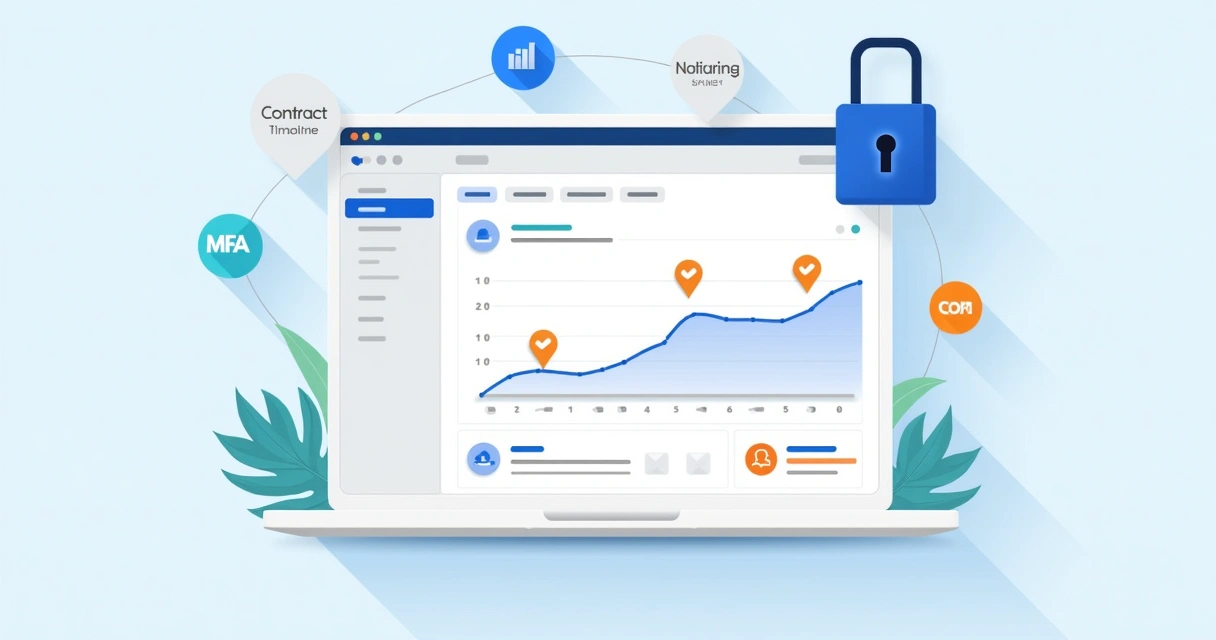
CloudSign.ie specializes in exactly this: a single, AI-powered platform that covers every step of the document process. You don’t just “attach” security features. Instead, they work together from the first draft to renewal notifications, allowing risk-based control for every document. Unlike other popular digital signature tools, CloudSign.ie harnesses artificial intelligence not just for automation, but for document analysis, risk detection, and tailored consent, making sure no contract or form falls through the cracks.
If you’re curious about feature comparisons, you can review security strengths of leading electronic signature services, but notice how CloudSign.ie consistently offers tighter integration and built-in intelligence. See more on that in this feature breakdown.
Practical workflow scenarios with unified security
I find the best way to highlight this is by walking through how security adapts to the real world:
- Sales sending standard NDAs or routine agreements: Quick e-signature with passcode or SMS verification, controlled through the same audit trail as every critical document.
- HR teams managing consent forms or employment contracts: Built-in ID checks and compliance templates, making candidate onboarding smoother and reducing legal risk.
- Legal or regulated industries: Multi-factor, notary, and multi-layered SSO checks for every step, complete with signed, defensible records for the most sensitive documents.
- Partnerships and board approvals: Options for additional levels of sign-off, because not every deal is made the same way. Same unified trail.
A scattered stack simply can’t offer this, no matter how many features each vendor lists.

I have also seen in practice how signs of data breaches in document workflows often trace back to these hidden cracks, separate authentication, inconsistent controls, fragmented tracking. The companies who moved to unified, AI-enabled platforms saw those risks disappear.
What should you look for in a document security platform?
In my view, there are clear priorities for anyone moving beyond the patchwork model:
- Connected security features. SSO, MFA, ID verification, notary, all a single, logical flow.
- Flexible authentication. Ability to adjust verification depth to the sensitivity of the document and user risk.
- Certifications that apply equally across the platform. Not scattered, not limited to one stage or segment.
- Unified audit trail. One source of truth, covering creation, edits, signing, and access events, always audit-ready.
- Single vendor simplicity. Fewer contracts, smoother support, and no finger-pointing if an issue appears.
Platforms like CloudSign.ie don’t just offer a checklist of features. They make everything work as part of one process, from risk analysis (more on that in how AI detects fraud in digital document signing) to automated renewals, adapting to contracts, regulated industries, or high-stakes deals.
Feature lists are not enough: it’s about integration and real coverage
I’ve seen how many digital signature platforms, whether it’s DocuSign, Dropbox Sign, or PandaDoc, promise every security box ticked, but when you dig deeper, integration ends up limited. This is where CloudSign.ie stands out, going beyond the feature matrix into actual, tailored workflows, AI-powered risk analysis, and unified oversight right across the document lifecycle.
If you want to compare in detail, I find the true business benefits of electronic signature solutions are much easier to achieve when you start from a single, properly connected platform.
Conclusion: collect features or collect results?
You can keep stacking security features from different providers and carry the headaches, or switch to a unified platform and get airtight, adaptive coverage from day one. That’s the choice I’ve seen make all the difference for teams from freelance consultants to multinational companies, especially those who value peace of mind and readiness for tomorrow’s security challenges.
If you want to see how unified document security could protect your business (and your sanity), I highly suggest seeing a CloudSign.ie demo. It’s the quickest way I know to truly understand what modern, adaptable document security looks like, from simple contracts to fully notarized, regulated agreements, all on your terms.
Frequently asked questions about unified document security
What is a unified document security platform?
A unified document security platform brings every layer of protection, authentication, signature, ID verification, audit trail, and compliance, together into a single, integrated system rather than separate tools managed by different vendors. This ensures coverage across the entire lifespan of your documents, making control much clearer and easier to enforce.
How does a unified platform improve security?
It eliminates gaps that exist when using different vendors and logins, giving you end-to-end control, stronger audit trails, and adaptable verification for every document type. With everything connected, there’s no place for attackers or mistakes to hide, and compliance can be proven with just a few clicks.
Why do most document security solutions fail?
Most solutions fail because they rely on a patchwork of separate features and vendors. Without true integration, there are hidden cracks in authentication, inconsistent compliance, and scattered audit trails, which increase risk and slow down business processes.
Is it worth switching to a unified platform?
From my experience, yes. A unified platform cuts out hours of wasted time, reduces errors, and prevents compliance headaches. Teams can focus on work, not managing technology gaps. The reduction in security risks and vendor complexity justifies the transition, especially for businesses with sensitive or regulated documents. I have seen firsthand how teams free up resources and reduce stress almost immediately.
What are the benefits of unified security?
You gain stronger protection, lower breach and compliance risk, faster workflows, a complete audit trail, and a single source of support, all while adapting security controls to each document’s real needs. Compared to disjointed systems, unified security means fewer mistakes, quicker audits, and more confidence for leadership, clients, and regulators.